Friday, December 30, 2011

The Bowery Boys Year In Review -- and the 1,000th post!

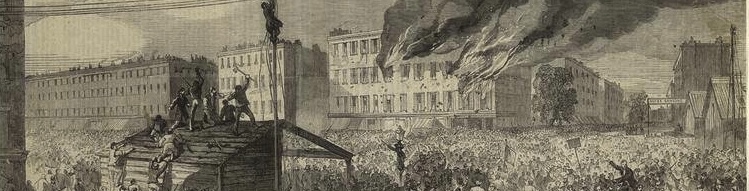
Here's a listing of all the podcasts we recorded in 2011. This year we followed New York's contribution to electricity and film, bridged the Narrows and took to the sky, revisited the Revolutionary War via the city's most influential tavern, and spent the summer surviving riots and conspiracies cooked up during the Civil War. If you missed any, you can download directly via the links below, or find us on iTunes or other podcast aggregate sites.

Our podcasts #120 NYC and the Birth of the Movies and #127 The Civil War Draft Riots and  were our most popular shows of the year, but our most downloaded show of 2011 was recorded in December 2010 -- #118 Times Square.

We both would like to thank everybody for listening in this past year! And we look forward to bringing you new tales of the city in 2012. Also, if everything falls in place, we'll be doing our first real expansion into different media next year.

This is also my 1,000 post for the Bowery Boys: New York City History blog. Onward to 2,000!

#119 The Verrazano-Narrows Bridge


#120 NYC and the Birth of the Movies

#121 Fraunces Tavern
Click here to download 


#122 The Grid - The Commissioners Plan of 1811


#123 TRUMP


#124 Idlewild/JFK Airport
#125 Sardi's Restaurant

#126 Fernando Wood: The Scoundrel Mayor

#127 The Civil War Draft Riots
Click here to download 

#128 Hoaxes and Conspiracies of 1864
Click here to download 
Blog page: Welcome to 1864! A 24-karat hoax, New York's first theme restaurant, and a Confederate plot to torch the city


#129 Chinatown
Click here to download 
Blog page: Manhattan's Chinatown: A tribute to the old neighborhood, and to the temptations of rich delicacies and basement vices


#130 Haunted Histories of New York
Click here to download 
Blog page: Haunted Histories of New York: What horrors lie beneath the foundations of the city's treasured landmarks?


#131 The First Apartment Building
Click here to download 


#132 Electric New York: Edison and the City Lights
Click here to download
Blog page: Electric New York: From gaslight to Edison's Pearl Street Station, illuminating the shadows, re-visualizing the night

Thursday, December 29, 2011

If Wal-Mart can't come to Brooklyn, then Wal-Mart will bring Brooklyn to Arkansas


Francis Guy hangs in good company at the Crystal Bridges Museum.

Wal-Mart is aggressively lobbying to bring its chain of big box stores to the New York City region. In the meantime, a member of the Walton family is buying up bits of New York and taking it back to Bentonville, Arkansas, the headquarters of Wal-Mart located in the Ozark Mountains.

I just got back from visiting my parents who live in neighboring Missouri and swung by Bentonville to visit the Crystal Bridges Museum of American Art, which recently opened in November, the project of Alice Walton, daughter of Wal-Mart founder Sam Walton. It lands in the region a bit like an alien spaceship, its arched and twisted architecture (think L.A.'s Getty Center as inspired by dinosaur fossils and river gulches) just one mile away from the quaint storefront-turned-museum that was the very first Wal-Mart store.

Alice Walton did an infamous tear through the art scene in the last two decades, buying up a great many well-loved works in anticipation of this project. Along the way, she also bought up a significant area of Brooklyn.

Or rather, its most famous early depiction. Francis Guy was one of America's earliest landscape masters, making his home in the village of Brooklyn in 1817. From then until his death in 1820, he painted what interested him from his second floor window on 11 Front Street, a series of panoramic, cool-hued works capturing both Brooklyn's bustle and serenity.

The Brooklyn Museum proudly displays one version of Guy's spectacular work, called 'Winter Scene In Brooklyn'. But the other version of this painting now sits in Arkansas, at Crystal Bridges. It sits in a  prominent place indeed, across from a Gilbert Stuart portrait of George Washington and a noble portrait by John Trumbull of the man the Stuart portrait was painted for, Alexander Hamilton. They're all in great company in this warm, expansive new building.

By the way, his version of 'Winter Scene' once sat on loan next to its companion at the Brooklyn Museum in 2006. The Brooklyn Historical Society has Guy's summertime version of this view.

Saturday, December 24, 2011

Pre-Scrooged: The Ghost of New York Christmas specials


A Bill Murray holiday classic is closely linked to a forgotten 1955 teleplay

Tracing itself back to one of America's first television broadcast station, New York's local WCBS-TV can claim a host of significant achievements, including the first regular broadcasts in color and the first baseball game in color (with the Brooklyn Dodgers, naturally).

Their early news documentary series 'Eye on New York', hosted and produced by future CBS president Bill Leonard, took a break from serious reporting on the evening of Christmas 1955 to broadcast a live version of Charles Dickens' 'A Christmas Carol'.  I don't believe a version of this classic exists to view today, but holiday television lovers benefit from one odd quirk of this fleeting program.

At right: Bill Leonard with CBS News correspondent Walter Cronkite.

This version of 'Carol' starred the extraordinary Bronx-born character actor Jonathan Harris (best known as the flamboyant Dr. Smith from 'Lost In Space') as Ebenezer Scrooge and Tony Award nominee Biff McGuire as Bob Cratchit.

But far from constructing a dour Victorian London set upon their midtown Manhattan soundstage, Leonard (who wrote the teleplay) decided to change the setting of the story, to modern day New York City. According to author Fred Guida, "this clever conversion preserved the spirit of the original but in the milieu of lower Park Avenue and big industry."

Harris' Scrooge was transformed into the bitter old CEO of Metropolitan Plastics, with Cratchit his elevator man. Scrooge was visited by the various ghosts via "a TV receiver as an up-to-date medium for his unearthly visions," according to Variety.

Leonard's 'Carol' was the very first version of the tale set in New York, and with a modern twist. While this original program has been lost, its cheeky trope has been used in a great many modern shows (especially those of the 1970s and 80s) in 'very special Christmas episodes', to bring holiday realizations to jaded characters from Alex P. Keaton of 'Family Ties' to even the title character of 'Xena: Warrior Princess'.

But the greatest beneficiary of Leonard's holiday twist is the 1988 Bill Murray classic 'Scrooged', where a grumpy New York television producer -- filming his own version of 'A Christmas Carol' -- finds epiphany after an evening with three illuminating spirits, including a cab driver played by former New York Dolls singer David Johansen.

And since we're on the subject, here's some more New York holiday themed cheer from Johansen, under the name of his alter ego, Buster Poindexter. Happy holidays from the Bowery Boys!

Thursday, December 22, 2011

'Christmas or Chanukah?': NYC discovers the Jewish holiday

Early news reporting on the celebration of Hannukah (or Chanukah, as it was popularly referred then) in New York usually took a arms-length approach, as most of their readership knew little about the celebration 100 years ago. More than one old Tribune or World carried a variant of the headline 'Jews Celebrate Chanukah' , as though there might have been some doubt. A 1905 headline informs: 'Chanukah, Commemorating Syrian Defeat, Lasts Eight Days.'

It wasn't just non-Jews that were misinformed about this seemingly mysterious holiday. A December 1894 edition of the New York Sun asks 'Christmas or Chanukah?' as a prominent rabbi from Temple Emanu-El (pictured at right, in its Fifth Avenue incarnation) "rebukes the tendency of Jews to confuse the festivals." In fact, many Jewish leaders at this time were concerned that many traditions were being abandoned, the better to acclimate in a city that was decidedly more Christian-seeming. 

The wife of American Jewish scholar Richard Gotthell* worried in 1900 that "this festival occurs so nearly coincident with the Christian festival of Christmas that there is danger that the observance of one may be lost in a gradual assimilation with the other."

But with the mass immigration of Eastern European Jews to New York in the 1900s, soon thousands celebrated the holiday -- and newspapers could hardly be so cavalier.

One event they took particular note of was the Chanukah celebration by the Federation of American Zionists, at the Herald Square Theater on January 1, 1911. One anecdote sprang out at me: "Dr. S. Levin spoke in Hebrew for an hour, on 'Jewish Life and Art.' He took exception to a certain Jewish speaker who recently declared that the Jews had produced nothing in art. Dr. Levin asserted that he was greievously wrong."

Across town at that very moment, a young Russian Jew named Irving Berlin was hammering out tunes in Tin Pan Alley and would debut, just a couple months later, 'Alexander's Ragtime Band', while other songwriters of Jewish heritage, such as Jerome Kern, were right then hard at work reinventing the American songbook. So, yes, Dr. Levin, grievously wrong.

And of course, these Jewish songwriters would go on to even help reinvent Christmas itself via a flurry of popular holiday tunes, like Berlin's own 'White Christmas.'

*Gotthell was also the founder of America's first Jewish fraternity, Zeta Beta Tau, formed in New York in 1898.

Wednesday, December 21, 2011

Christmas in the afternoon: A tour around Greeley Square


I'm not 100% sure on the date of this photo, but I'll place it in the late 1940s, as Life photographer Nina Leen did a great many photoshoots for the magazine in this period. The statue of Horace Greeley sits astride the big Christmas tree as perfect afternoon light casts shadows upon the corner of 33rd and Broadway. Here's a slightly different angle of the same scene.

Gimbels, at left, one of America's largest department store chains in the 1940s, was presumably filled with shoppers. The building to its north was is Sak's Herald Square, the ancestor of the far swankier Saks Fifth Avenue. Out of view at 34th Street is, of course, Macy's.

The Hotel McAlpin, at right, was once the biggest hotel in the world when it was built in 1912. The storefront that sits at the corner of 33rd and Broadway is Crawford's men's clothing store. Today that same corner is occupied by Game Stop.

On the southeast corner of 33rd and Broadway was Whelan's Drugstore, an New York drug store and soda fountain chain in its heyday during the 1940s and 50s. Its business neighbor was Young's hat shop, specializing in Stetsons.
Related Posts Plugin for WordPress, Blogger...