Showing posts with label Civil War. Show all posts

Tuesday, April 17, 2012

Commodore Nutt: Barnum's dwarf star, NYC police officer

The attentions of most New Yorkers 150 years ago today were understandably occupied by the events of the Civil War. The general mood in April 1862 had turned cynical and grim. It had been one year since the first battle at Fort Sumter. The bloodiest skirmish yet, the Battle of Shiloh in northwestern Tennessee, left thousands dead on the battlefield just two weeks before, and attention now turned to the standoff at Fort Pulaski.

And yet the city in April 1862 was overflowing with distraction. The jewellers Ball Black & Co. displayed a framed personal letter from Queen Victoria, thanking New Yorkers for their well wishers following the death of her husband a few months earlier. Across the street, at Niblo's Garden, theatergoers could delight in 'The Enchantress', featuring actor William Wheatley, who would later stage the world's first Broadway musical, 'The Black Crook', on that very stage. Merry gentleman and naughty ladies drank up in lower Manhattan's various concert saloons, bracing for the effects of a new law passed that month that would effectively close down such bawdy amusements. (Luckily, the law had little effect.)

But New York's merry king of showbiz in 1862 was P.T. Barnum, his American Museum still New York's most popular attraction. That April, Barnum featured a 'living hippopotamus' and two beluga whale in its basement, and among the museum's many shows at Broadway and Ann Street was the feature 'Hop O' My Thumb, or The Ogre And The Dwarf' starring Barnum's biggest small star General Tom Thumb.

Thumb, however, was not Barnum's only dwarf star in 1862. Earlier that year, Barnum unveiled a New Hampshire teenager afflicted with dwarfism and presented him with the stage name Commodore George Washington Nutt. Known as the '$30,000 Nutt' due the amount of money he was supposedly paid (although later disproven), the young man was advertised as "the Smallest Man in Miniature in the known world" and "Most Attractive and Interesting human being ever known."

At right: Nutt in an illustration from Harpers Weekly, February 1862, 'bursting out of his shell'

Although Nutt would perform at the museum, he was frequently used as an instrument to promote Barnum's many endeavors. He would serve as Tom Thumb's friendly rival for the hand of diminutive actress Lavinia Warren (whom Thumb later married at Grace Church in 1863) and tour throughout Europe with Barnum. But on April 17, 1862, Nutt had a local duty to perform -- at the headquarters of the New York Police Department.

According to the Daily Tribune, Nutt met with local police commissioners in an effort to get an officer specifically assigned to Barnum's museum. And just in case the idea would be met with indifference, Nutt himself applied to become a New York police officer, although his height of three feet might have precluded him from such an occupation.

A uniform was immediately ordered for the young star, and by telegraph to the Ninth Precinct, he claimed he would hold 'extraordinary powers to arrest' troublemakers at the Museum. It appears, however, that Nutt held few responsibilities for the police force.

During his tour of the police facilities, including the famed Rogue's Gallery, the charming performer even got in a rather dirty joke. According to the article, "Some one said that on the stage the Commodore had been seen to kiss a girl on the mouth. 'Well, that was the right place, wasn't it?' was the reply."

Top picture courtesy NYPL


Tuesday, February 28, 2012

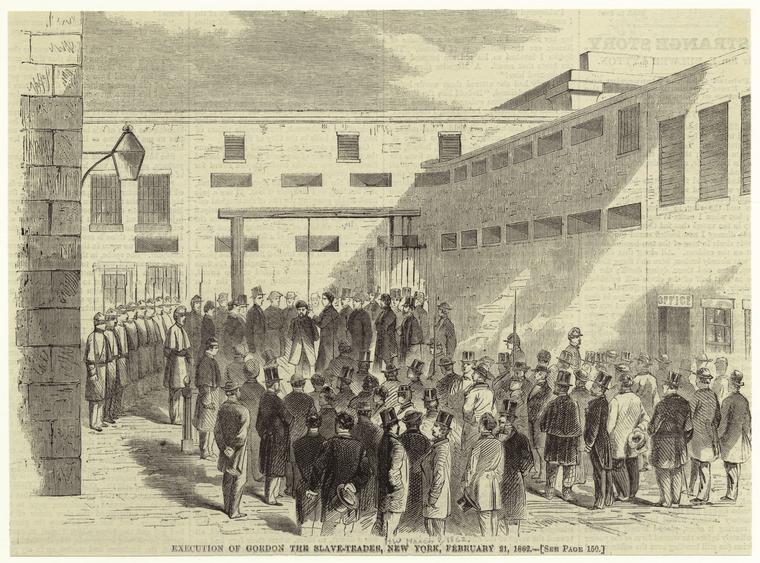
Execution in Five Points: Piracy, slave trade and the Tombs


Sometimes you can look back at history and think that nothing ever changes. And sometimes you find something that makes New York seem extraordinary unrecognizable, a city besieged by near barbaric crises.

The image above depicts a scene from February 21, 1862, in the courtyard of the famous Tombs prison in the Five Points neighborhood. The notoriously dank and foul-smelling complex was the scene of a great many public executions since its opening in 1838, but the one which took place on February 21 was particularly urgent, the crime cutting to the core of America's central dilemma.

The man being hanged was Nathaniel Gordon, and his crime was international slave trade. America was in the throes of a Civil War between the North and South, waged with slavery as its central issue. But the import and export of slaves into the United States has technically been banned decades earlier, and the U.S. Piracy Act of 1820 included human cargo in its definition of international piracy. This did not deter Gordon, who sailed to North Africa in 1860 and loaded a boat with almost 900 people, intending to sell them to Southern plantations.

From a vivid description from Harper's Weekly, the boat was overloaded with "eight hundred and ninety-seven (897) negroes, men, women, and children, ranging from the age of six months to forty years. They were half children, one-fourth men, and one-fourth women, and so crowded when on the main deck that one could scarcely put his foot down without stepping on them. The stench from the hold was fearful, and the filth and dirt upon their persons indescribably offensive."

Gordon was caught just 50 miles offshore and brought to the United States for trial. He would have received a stern sentence even before the war, but with the conflict in full swing by the time of his trial in late 1861, Gordon's defense team never stood a chance. Despite pleas from wealthy supporters, Gordon was sentenced to die on February 7, 1862. President Abraham Lincoln commuted the sentence by two weeks, and Gordon's supporters might have even convinced him to commute it further had Lincoln's young son Willie not died of typhoid on February 20.


One notable fact about this execution is the Tombs (pictured above, in 1863) is a city prison, but the crime was a federal offense, the only such national execution to have taken place here. Most federal executions took place at military installations. For instance 'Pirate' Albert Hicks was hanged on Bedloe's Island, home of Fort Wood (and today the residence of the Statue of Liberty). Robert Cobb Kennedy, one of the Confederate conspirators who attempted to torch various New York hotels in November 1864, was executed at Fort Lafayette off the coast of Bay Ridge, Brooklyn.

Gordon was also the last person ever executed by the U.S. government for violations of the Piracy Act.

For more details on the execution, check out the great Corrections History blog which details the messy particulars of the execution.

Illustration above courtesy New York Public Library


Friday, January 6, 2012

The Fifth Avenue Hotel: Opulence atop a potter's field, and accommodations for heated Republican power brokering


By the date of this photo (1890), the Fifth Avenue Hotel, facing Madison Square Park, had already seen its share of American political drama.


The double-breasted, cigar-chewing gentlemen who gathered in the sumptuous rooms of the Fifth Avenue Hotel were occasional connoisseurs of New York City history, and in particular, these amateur historians spoke of the very street corner where their hotel stood.

Before Madison Square, when the area was a barren parade ground, one Corporal Thompson opened a roadhouse and stagecoach station in the area that was to become 23rd Street and and Fifth Avenue. Many spoke fondly of Thompson's establishment, called Madison Cottage, because they remembered the place as young boys. They recalled the area's rural quality, with carved rectangular blocks carved into the land and a dirt-road Broadway meandering north.

But that was the 1840s. Forty years later, Madison Square Park was the center of New York, a focal point of class, business and luxury that stretched south to Union Square, through that attractive collection of fine stores known as Ladies Mile, and up Fifth Avenue into the fabulous mansions of the rich. And dead center of all that activity was the Fifth Avenue Hotel, not only the "finest [hotel] in this metropolis", the "leading hotel of the world ," but quite simply one of the most surprising stages for American politics of the mid and late 19th century.

Hotels were fast becoming the center of New York life from at least the days of the Astor House, located near City Hall, in the 1830s. Within two decades, trendy new hotels (such as the St. Nicholas and the Metropolitan) spread up along Broadway and eventually clustered around Union Square. By the Civil War, the thrust of New York society was so defined by them that Confederate conspirators tried setting fire to a several of them.


The Fifth Avenue Hotel opened in 1859, the venture of wealthy merchant Amos Richards Eno, who accurately gambled that the center of city commerce would soon settle at 23rd Street. So confident a speculator was Eno that he moved from his brownstone at 74 Broadway (the first New York brownstone, he claimed) to a massive home nearby the hotel.

Some thought it unwise to build so far north, and when workers unearthed dozens of skeletons during construction -- the area once being a potter's field -- the corner was even considered cursed. Eno defied the naysayers, pouring his wealth into the hotel to make it the most modern, most luxurious accommodation of the day.

The Italian exterior was awash in five stories of imported marble, while austere, carpeted interiors of French design drew comparisons to European palaces. Guests enjoyed reading rooms, a luxurious bar, a barber shop, a dedicated telegraph office, and a variety of dining and drawing rooms, not to mention the first passenger elevator ever built in the United States, a steam-powered monstrosity whisking passengers to their floor.  The private quarters were soundproofed, fixtured with the modern innovations in plumbing, and lavishly decorated, becoming to many "the safest, the most healthy and most comfortable hotel in the world."

As the finest hotel in the city in the post Civil War years, it naturally became a magnet for politicians and financiers. Of all the 'backrooms' of American politics, none were as gleaming as the Fifth Avenue. Bankers huddled in the legendary 'parlor D. R.' during the tense days of the financial panic of 1873. In particular, the hotel became a de facto headquarters for New York Republicans. While often secondary to the city's Democrats -- this being the era of Tammany Hall's swelling power -- Republicans were frequently in control of state government, and the Fifth Avenue Hotel became a smoky center of political wheeling and dealing.

During the 1870s, New York republicans became national power brokers and frequently hashed out crises here at the Fifth Avenue. In the years before the Waldorf-Astoria, presidents and dignitaries all stayed here during visits. Seamier political maneuvers took place in the chambers of prominent politicians who held court here, including the inimitable Roscoe Conkling (at left), senator of New York and leader of the Republican faction known as the Stalwarts.

When fractured Republicans at their convention in 1880 nominated non-Stalwart James Garfield for president, the nominee had to basically grovel for their support by symbolically 'kissing the ring' of the Stalwarts during a visit to the Fifth Avenue Hotel, partially agreeing to their system of patronage and taking Conkling ally Levi Morton as a member of his cabinet. (Garfield later backed out on this arrangement.)

Another frequent guest here was Chester A. Arthur, Garfield's eventual vice president. When Arthur became president after Garfield's assassination by Charles Guiteau (who had himself wandered the hotel's hallways in delusion), he would set up his entire administration here during visits to his adopted city.

By the 1890s, a corridor of the hotel known as the 'Amen Corner' was a famous congregation spot for Republican political bosses and reporters. As they frequently powwowed here on Sundays, gatherers would caustically shout 'Amen!' during heated discussions.

The hotel became a magnet for shenanigans of all varieties. In 1893, a couple hundred proponents of a U.S. monetary silver standard erupted into a riot that included two U.S. senators. The bank robber Robert Montague was arrested here in 1896 thanks to a tip-off from a chambermaid. An early vestige of baseball's National League met here annually, and the national pool competitions were held in the hotel's billiard room.

By the new century, of course, the locus of New York activity was hastily moving uptown, and the Fifth Avenue Hotel was deemed a relic, even as a brand new structure across the street -- the Flatiron Building -- was being proclaimed the finest building in the city. In 1908 the Fifth Avenue Hotel was torn down and replaced by the 16-story Toy Center (called the Fifth Avenue Building back in the day), the epicenter of toy manufacturing for much of the 20th century.

Pictures courtesy New York Public Library (source)
Related Posts Plugin for WordPress, Blogger...