Showing posts with label Abraham Lincoln. Show all posts

Friday, March 23, 2012

The Bowery Boys High Line audio walking tour, featuring tales of the Titanic, the Manhattan Project and 1,000 Stevies


Cookie heaven: Trains pull into a factory owned by the National Biscuit Company, between W. 15th and 16th streets, July 30, 1950. Could those cars be filled with crates of freshly made Oreo cookies? (See comments section below for the anser.) By 1958, the snack company had pulled all production from New York's west side. Photo courtesy Ed Doyle/Flickr


PODCAST Welcome to our unofficial High Line audio walking tour! In our last podcast (episode #135), we gave you a history of the High Line, the one-mile linear park situated atop a stretch of abandoned elevated railroad tracks along the West Side. This time, I'll take you on a tour along the High Line itself.

This will incorporate some history of the elevated line itself, but it's geared towards describing the history of the surrounding neighborhoods. This is intended to be listened to as you walk along the High Line, beginning at the park's southern entrance at Washington Street and Gansevoort Street in the Meatpacking District. We'll end at 30th Street. This tour will last a little over an hour or so -- depending on what speed you choose to enjoy the High Line. But take your time!

Along the way, I'll share tales from almost 200 years of history, from the early days of Fort Gansevoort during the War of 1812 to the underground club life of the 1990s. Featuring New York stories of the Titanic, the Lusitania and the Manhattan Project. And starring a wild array of people who have influenced these neighborhoods, including Abraham Lincoln, Cornelius Vanderbilt, Drew Barrymore, REVS, Cass Gilbert, a feisty lady named Tillie Hart, and a whole lotta people dressed like Stevie Nicks.

ALSO: You might want a handful of Oreos after you're done.

To get the walking tour, simply download it for FREE from iTunes or other podcasting services, subscribe to our RSS feed or get it straight from our satellite site.


Or listen to it here:
The Bowery Boys High Line Walking Tour


This tour covers two hundred years of history, starting with the construction of Fort Gansevoort, built to protect the city from potential attack during the events leading up to the War of 1812. (Courtesy NYPL)


A map of the High Line, courtesy the Friends of the High Line. This walking tour follows this path directly from the southernmost entrance at Gansevoort Street, all the way up to W. 30th Street.


If you're not able to walk the High Line anytime soon, never fear! Google Maps actually allows you to 'walk' the High Line.

 
View Larger Map

Although you won't experience any vehicular traffic on this tour, please be aware of other visitors to the High Line as you listen. Stand over to the either side as you listen. There are some narrow paths, uneven walkways, benches and other nooks built into the surface of the High Line, so watch your step.

At the end of the tour I mentioned a Chelsea gallery tour that also provides a great perspective on the neighborhood while leading you through the scene's best art shows. You can find more information about tours at New York Gallery Tours. In addition to the Chelsea scene, they also provide guided tours of the Lower East Side and Upper East Side art scenes.

CORRECTION: There is a very hilarious mis-statement near the end of the show. The Morgan Processing and Distribution Center is 2.2 million square feet, NOT 2.2 square feet. That would be the size of a flower box, I think. I've added the correction to the podcast show notes.
Tuesday, February 28, 2012

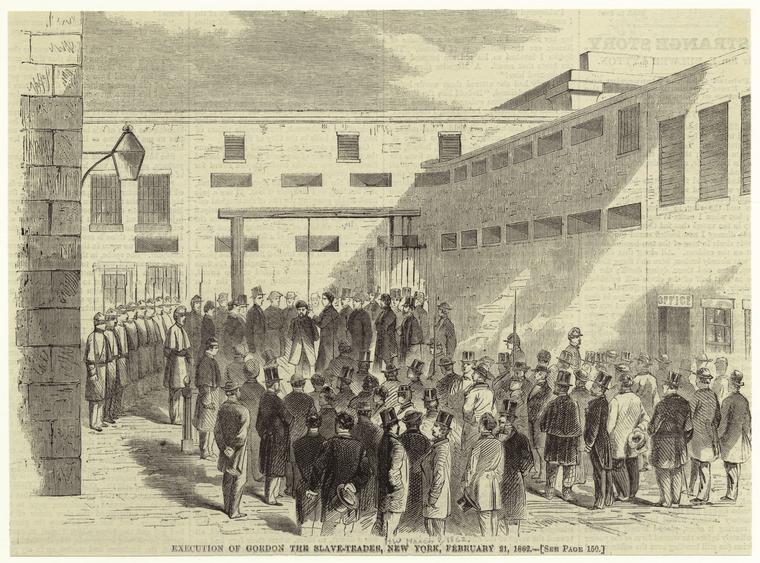
Execution in Five Points: Piracy, slave trade and the Tombs


Sometimes you can look back at history and think that nothing ever changes. And sometimes you find something that makes New York seem extraordinary unrecognizable, a city besieged by near barbaric crises.

The image above depicts a scene from February 21, 1862, in the courtyard of the famous Tombs prison in the Five Points neighborhood. The notoriously dank and foul-smelling complex was the scene of a great many public executions since its opening in 1838, but the one which took place on February 21 was particularly urgent, the crime cutting to the core of America's central dilemma.

The man being hanged was Nathaniel Gordon, and his crime was international slave trade. America was in the throes of a Civil War between the North and South, waged with slavery as its central issue. But the import and export of slaves into the United States has technically been banned decades earlier, and the U.S. Piracy Act of 1820 included human cargo in its definition of international piracy. This did not deter Gordon, who sailed to North Africa in 1860 and loaded a boat with almost 900 people, intending to sell them to Southern plantations.

From a vivid description from Harper's Weekly, the boat was overloaded with "eight hundred and ninety-seven (897) negroes, men, women, and children, ranging from the age of six months to forty years. They were half children, one-fourth men, and one-fourth women, and so crowded when on the main deck that one could scarcely put his foot down without stepping on them. The stench from the hold was fearful, and the filth and dirt upon their persons indescribably offensive."

Gordon was caught just 50 miles offshore and brought to the United States for trial. He would have received a stern sentence even before the war, but with the conflict in full swing by the time of his trial in late 1861, Gordon's defense team never stood a chance. Despite pleas from wealthy supporters, Gordon was sentenced to die on February 7, 1862. President Abraham Lincoln commuted the sentence by two weeks, and Gordon's supporters might have even convinced him to commute it further had Lincoln's young son Willie not died of typhoid on February 20.


One notable fact about this execution is the Tombs (pictured above, in 1863) is a city prison, but the crime was a federal offense, the only such national execution to have taken place here. Most federal executions took place at military installations. For instance 'Pirate' Albert Hicks was hanged on Bedloe's Island, home of Fort Wood (and today the residence of the Statue of Liberty). Robert Cobb Kennedy, one of the Confederate conspirators who attempted to torch various New York hotels in November 1864, was executed at Fort Lafayette off the coast of Bay Ridge, Brooklyn.

Gordon was also the last person ever executed by the U.S. government for violations of the Piracy Act.

For more details on the execution, check out the great Corrections History blog which details the messy particulars of the execution.

Illustration above courtesy New York Public Library


Related Posts Plugin for WordPress, Blogger...