Showing posts with label Red Hook. Show all posts

Wednesday, February 22, 2012

The Big Wind of 1912: New York skyscrapers in peril, as monster gales hurl "men and women down city streets"


Trauma in Times Square: An electrical sign destroyed by the massive windstorm of February 22, 1912. One Times Square sits to the left, and the Hotel Astor is in the distance. [LOC] Shorpy has an another angle of this damaged storefront.

"The great gale that blew in with Washington's birthday will not soon be forgotten. It was the biggest New York ever knew." -- New York Evening World, Feb. 23, 1912

 I hope you'll indulge me for just one more post about life in February 1912. In fact, my last two posts on pilot Frank Coffyn and the exhausted women of Astor Place have led up to this event, a catastrophic weather anomaly which occurred on February 22, 1912, an event the New York Times referred to as 'The Big Wind'.

This particular day has also been called "a significant day in the history of tall buildings," although I doubt anybody today will be celebrating this rather vicious and sudden test of architectural endurance.

New Yorkers thought it might be worse. The storm system began the previous day as a blinding Midwestern blizzard, paralyzing the railroad and killing cattle. St. Louis received its greatest snowfall ever up to that time from this churning storm, and Chicago reported winds of up to 50 miles per hour. If it held this pattern by the time it hit the East, New Yorkers feared another storm of the level of the Blizzard of 1888, which buried the city in snow, rendered transportation useless, and killed more than 200 people.

In one respect, the city was fortunate that snowfall was relegated to upstate New York. The grim meteorological trade off, unfortunately, was a day of powerful, otherworldly wind gusts, almost double the strength of those during the infamous 1888 storm.

The worst of it came after midnight, when a terrifying frozen bluster "swooped down on the city with all its length and breadth" at speeds of 96 miles per hour. At one point, devices in Central Park registered an unthinkable 110 miles per hour. By morning it had settled to 70 miles per hour and held that speed steady for much of the day. [source]

Some called this "giant among gales" a day-long cyclone, and it certainly acted like one -- uprooting trees, destroying rooftops and even depositing whole houses into the river. People were blown off their feet, carts went flying and pedestrians dodged falling telephone poles in terror. Most leaving home wearing hats ran back inside without them.  If any of those women from yesterday's Astor Place post were trekking through the plaza with their home-work today, they most likely lost it to the wind.

Foremost on the minds of most New Yorkers was the fate of its skyline. In 1888, during the last harsh storm, there were no skyscrapers. In 1912, there were several over 30 floors, including the city's tallest, the 50-floor Metropolitan Life Insurance Tower off Madison Square. Although most buildings were designed to withstand significant wind trauma, none of them were prepared for winds above 70 miles per hour. And the building slated to become the next tallest in New York -- the Woolworth Building -- was still under construction, its metal skeleton now a potential arsenal of deadly debris.

Panes of glass shattered throughout the city, but it appears most of New York's tallest structures survived without significant damage. In fact, it was the shorter, older structures that fared worst, many of them designed with little protection from powerful winds.

Below: the downtown Manhattan skyline in 1912. Most of these buildings survived the 'Big Wind' with only damage to their windows. [pic]

Not that modern invention came away unscathed that day. The electrical signs of Times Square, many no more than a few months old, were no match for the powerful gusts. Several were destroyed, including a one provocative sign at 47th Street, featuring "two scantily clad electric boys who box nightly in Summer underwear." [source] Next to the Hotel Knickerbocker, a 200-foot electric sign crumbled to the sidewalk below in front of Hepners Hair Emporium, a police officer racing into the establishment a minute before the sign crashed into the plate glass window of the railroad ticket office next door.

Across the street, at the Times Building, a drug store window exploded, and "many bottles of perfume and drugs" were hurled at passers-by.

Most boats all along the waterfront were either damaged or untethered. Predictably, beach houses on Rockaway Beach and other quieter locales fared the worst. The luckiest structures survived with nary a window remaining; those less fortunate were found floating offshore. In Astoria, Queens, the roof to the jail was taken off, to the fright of the occupants inside.
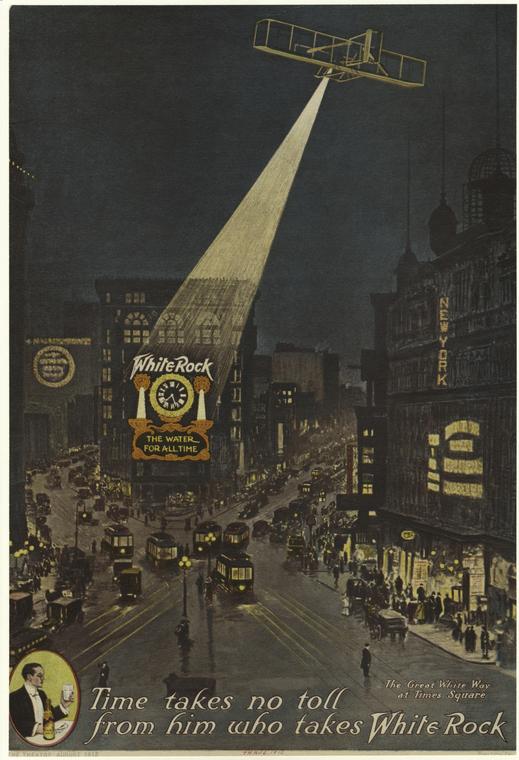
At right: Times Square in August 1912. The White Rock sign was probably not around for the February wind storm. The 'electric boys' sign described above sat at this intersection.

In Red Hook, Brooklyn, turbulent winds kept a raging fire alive at a brick manufacturing plant, distributing flaming pitch shrapnel to several buildings across the street, including a hay and horse feed dealership! (One of many reasons they don't keep hay dealerships in crowded cities today.) The brick factory, which took several hours to control, was about three blocks from the location of today's IKEA store.

February 22, 1912, happened to be the 180th anniversary of George Washington's birth, and hundreds of veterans tried marching from Jefferson Market to Union Square. Flags raised aloft in celebration were torn to ribbons. Nobody was injured, although the gusts caused major inconvenience, "Salvation Army object lessons and banner bearers bowled over by the wind."  [source]

Others were not as fortunate. The Times attributed at least one death to the storm and over a dozen concussions from flying debris, messenger boys and seamstresses blown into windows or railings or hit by signs or dislodged cornices. One man, waiting for his wife at St. Patrick's Cathedral, had his neck slashed by flying glass. Where physical harm was avoided, humiliation took its place. A society woman on Riverside Drive, wearing "superabundantly costly furs," was picked up and thrown into a horse.

Meanwhile, down at the Battery, Frank Coffyn was preparing for another takeoff off the water on his pontoon-equipped airplane. The wind had other plans, ripping the wings off the plane and spoiling Coffyn's plans. Later that day, Coffyn wired his old boss Wilbur Wright for replacement parts. (See my post from last week for more information of Coffyn's harbor flights..)

By the late evening, winds had died down to a mere 44 miles per hour. (For comparison, New York City's average wind speed today is just 12.2 miles per hour.) In the morning, things were back to normal -- except for huge mess of metal and glass left scattered on the streets.


Tuesday, January 17, 2012

Notes from the podcast (#133): Red Hook, Brooklyn


A haunting snapshot of the Atlantic Docks, circa 1870-80s (possibly as early as 1872) photo by George Bradford Brainerd (courtesy the Brooklyn Museum

Quite a few notes on the podcast this week! There were a lot of little details I found interesting that didn't make the cut:


Before the Water Taxi: One of the more enlightening tales left on the cutting-room floor was that of the Hamilton Avenue Ferry, the 1846 Atlantic Docks ferry line that linked Red Hook with downtown Manhattan in much the same way the IKEA Water Taxi does today. As the ferry made "the shortest and most direct route from New York" to the newly constructed Green-Wood Cemetery, it also became the method by which many bodies were transported there.

Fiery renovation: A stalwart of the old community is Visitation of the Blessed Virgin Mary Roman Catholic Church (built in 1896) right off of Coffey Park, the third incarnation after the congregation grew out of the first building (originally built in 1855) and fire destroyed the second. That fire, incidentally, was allegedly caused by combustible materials workers were using to renovate the structure.

Goodbye Vienna: A vestige of World War I hysteria exists within the name of Red Hook's Lorraine Street. According to Brooklyn By Name, the street was once named Vienna Street but was deemed 'offensive' during the war and was changed to reflect the area of Alsace-Lorraine, which entered French possession after the war.

What's My Name?: I mentioned a couple facts about the neighborhood of Carroll Gardens (once considered a part of Red Hook), although we hope to elaborate further one day on a show on South Brooklyn. The name Carroll Gardens, like that of its neighbors Cobble Hill and Boerum Hill, was a real-estate invention which the community quickly embraced. (Contrast this with modern failures of real-estate re-branding, like ChumboBelDel and LoDel.) You might be interested in reading Carroll Garden's original 1973 historic designation.

Below: I'm not quite sure of the story behind this sunken squatters home, taken on Van Brunt Street from the year 1900 (courtesy the Brooklyn Museum

Brooklyn Museum: Brooklyn scenes; buildings


Further reading: For more information on the corruption of the  New York and Brooklyn waterfronts , I highly endorse Nathan Ward's 'Dark Harbor'. It's brilliantly lucid and immediate. In particular, he focuses some attention on the disappearance of Columbia Street longshoreman Pietro Panto and vividly describes a mob hit that took place in a building in Manhattan's West Village, in a building next door to the treasured piano bar Marie's Crisis. There are several books that feature chapters on Red Hook history, but a dedicated book on the subject is sorely needed. In the meantime, I recommend the short essay by Jerry Nachman that appears in "Brooklyn: A State of Mind," about, of all things, an air conditioning crisis!

Maggie Blanck has an extraordinary web resource that begins as a genealogy of her family and elaborates into a history of Red Hook's industrial giants. And for those of you who are fascinated by late-century street-gang history, the website Stone Greasers has an exhaustive list of gang names, many more unusual than anything you'd find in the movie The Warriors.

Red Hook as inspiration: Several sources, both on Brooklyn history and film history, discuss Red Hook's impact on the work of both Arthur Miller and Budd Schulberg, the screenwriter of 'On The Waterfront'.

 In 2009, a unique restaging of 'On The Waterfront' took place aboard the Waterfront Barge Museum in Red Hook, a production that then floated to Manhattan and Hoboken waterfronts for further performances, "all places whose dock wars echoed in Terry [Malloy's] story," according to Ward.

Elia Kazan's Oscar-winning film is embedded with influences from the entire New York waterfront struggle. For instance, Karl Malden's Father Barry is transparently inspired by Father Corridan, an activist waterfront priest from Manhattan's west side. (Author J.T. Fisher focuses on Corridan's contribution in his new book 'On The Irish Waterfront'.) Of course no inspiration was greater than Malcolm Johnson's now classic series of articles for the New York Sun in the late 1940s, a series which won the Pulitzer Prize in 1949 -- coincidentally the same year that Miller won for 'Death of A Salesman'!

I suppose there is some controversy in some circles regarding whether Schulberg and Kazan 'stole' the idea of 'Waterfront' from Miller's 'The Hook', but I'm not touching that. However you can read about it yourself in Stephen Schwartz's argumentative 2005 article.

Thanks to commenter Rob Hill who calls to attention another fascinating literary Red Hook reference. In 1957, Harlon Ellison, one of America's great science fiction and crime novelists, literally went undercover with a Red Hook street gang called The Barons to find inspiration for his book 'Web of the City' and, later, in the non-fictional account Memos From Purgatory. Ellison's entire life would probably make a good subject for a podcast one day. Thanks Rob!

Further listening: This show shares many similar themes with our past shows on Williamsburg, Brooklyn and Corlears Hook and the Pirates of the East River. Hmm, and let's just say, we're probably coming back to the waterfront sooner than later this year....

Community vs Neighborhood: One listener Carolina from PortSide NY had some strong objections to my characterization of Red Hook, particularly my focus on the neighborhood's crime and gang activity. I'm excerpting part of her letter, as it highlights a challenge that Tom and I often tackle with our podcast:

"Red Hook housed great poverty, but for decades was more mixed economically than your focus on gangland stories describes. Personally, I find what is most distinctive about Red Hook over the years is the capacity of this small place to hold AT THE SAME TIME a striking economic range in its residents and a striking range of land use from major industry to residences."

That is an undoubtedly true statement, especially when you compare it to the fate of other dockside neighborhoods, like Corlears Hook and Water Street in Manhattan. I find there are two ways to accurately tell a story of a place like Red Hook -- from an organic, street-level or 'ground up' perspective (what I call 'a community history') and from a macro-view, as a component of the larger forces of the city which contain it (or 'a neighborhood history').

As the creators of a New York City history podcast, we opt to recount neighborhood histories, as New Yorkers and those who love this city are familiar with the mechanisms of change that have influenced it. In this decision, we understand that the normalcy of a place can get sometimes overlooked. (After all, not every person in Five Points was a gang member or a prostitute either.)

However, the sad truth is, Red Hook was for many years nationally known as a blighted neighborhood, and it was important to inspect both how it got that way and how that condition demanded some very unique revitalization plans.  I hope I have shown how essential Red Hook was to New York, and continues to be.  We encourage you to wander around the waterfront on a sunny afternoon sometime and, in particular, check out places like the Waterfront Barge Museum.

Friday, January 13, 2012

Red Hook, Brooklyn: A rich seafaring history, organized crime and the isolation of a beleaguered neighborhood


PODCAST Red Hook, Brooklyn, the neighborhood called by the Dutch 'Roode Hoek' for its red soil, became a key port during the 19th century, a stopping point for vessels carry a vast array of raw goods from the interior of the United States along the Erie Canal. In particular, two manmade harbors were among the greatest developments in Brooklyn history, stepping in when Manhattan's own decaying wharves became too overcrowded.

With these basins came a mix of ethnicities to Brooklyn, and along with new styles of row houses came the usual assortment of vices -- saloons and brothels along Hamilton Avenue. This fostered the development of crime along the docks, and Red Hook soon witnessed firsthand the opening salvos of 20th Century organized crime.

How did the history-rich, nautical neighborhood go from a booming center of employment to one of the worst neighborhoods in the United States by the 1990s? And can some surprising twists of fate from the last twenty years help Red Hook return to its glory days?

Featuring: Revolutionary War forts, shantytowns, Vaseline factories, famous gangsters, the gateway to Hell, and cheap Swedish furniture!

You can tune into it below, download it for FREE from iTunes or other podcasting services, or get it straight from our satellite site.

Or listen to it here:
The Bowery Boys: Red Hook: Brooklyn on the Waterfront

Notes, clarifications, sources, and additional information will be posted next week. Photo above: Taken on Van Brunt street, 1/11/2012

 The Atlantic Docks, illustration taken from Booth's History of New York. (care of NYPL)

Modern living, circa 1939. The Red Hook Houses at their debut. Although the housing development cleared away a great many dilapidated homes -- following a common model of urban redevelopment -- the uninspired uniformity would put a dent in the neighborhood's original character. (Courtesy LOC)


The Red Hook Play Center opened in 1936, the final of 11 swimming pools Robert Moses built during his early years as parks commissioner. Its Art Moderne style made it a beautiful if curious addition to the neighborhood.

The Erie Basin, a clutter of vessels and piers, is strangely beautiful from overhead in relation to the Manhattan skyline. (Pic courtesy Wired NY)

The crisis of organized crime and corruption within the longshoreman's union along the Brooklyn waterfront was an inspiration for many writers, including Arthur Miller (below) in his unproduced screenplay 'The Hook' -- referring both to the neighborhood and the longshoreman's "ever-present baling hook". Later, Elia Kazan and screenwriter Budd Schulberg found similar inspiration for the Oscar winning film 'On The Waterfront', loosely basing events on situations that took place along the entire New York and Brooklyn waterfront. (The film was made in Hoboken, but there are of course famous shots of the Manhattan skyline.)
Related Posts Plugin for WordPress, Blogger...