Showing posts with label Titanic. Show all posts
Tuesday, April 24, 2012
History in the Making: Double Decker Delight Edition
Ladies in their most decorative hats enjoy a sunny ride from a double-decker in the fleet of the Fifth Avenue Coach Company. Anybody recognize this street corner? There's an advertisement for McMullen's White Label Bass Ale, Guinness Stout, Appolinari's mineral water on the building in the background. (Photo by Alice Austen, courtesy NYPL. Labeled 1896, but most likely much later, perhaps early-mid 1910s)
Sage Advice: Sixteen tips and observations from an opinionated 1916 New York tour guide. "Another characteristic of New York, and one that applies to all grades of society, is the lavish and conspicuous mode of dress adopted by New York women on the public streets" [Cenedella]
Evergreen: It's Barbra Streisand's 70th birthday! Find out where she -- and 19 other extraordinary female vocalists -- got their start in New York's hustling nightlife in an older 2010 post from this blog. [Bowery Boys]
On the Menu: Dying to go to the Howard Johnson's restaurant depicted on last Sunday's 'Mad Men' episode and partake of a big, BIG orange sherbet? The Plattsburgh location is closed, but The Retrologist takes you to an original restaurant that's still open in Lake George. [The Retrologist]
Good Golly: The History Chicks podcast takes a look at the Titanic's most famous lady, the 'Unsinkable' Molly Brown. [The History Chicks]
The Wire: There are mysterious, almost invisible wires strung from lampposts all around the city. Ever notice them? [Slate]
Continuing Story: The latest on the embattled St. Mark's Bookshop, one of the last independent bookstores in the East Village. [Jeremiah's Vanishing New York]
Bronx Tracks: A meticulous truly adventurous walk along the old New York, Westchester and Boston Railway in the Bronx, with sights along Gun Hill Road, Dyre Avenue and stops near the old Freedomland amusement park. [Forgotten New York]
Commodious: The Brooklyn Historical Society takes a leap into the records of the Brooklyn Bureau of Sewers. [Brooklyn Historical Society Blog]
And, now, big news! We are very happy to announce our involvement as blog ambassadors for the Partners In Preservation grant program, sponsored by American Express and the National Trust For Historic Preservation. Forty historical places in New York City have been chosen to compete for $3 million worth of funding. It's a great chance for us to finally give back to some of New York's most treasured places we've spent years talking about. And you can help choose the grant awardees. More information on that this Thursday! [Partners In Preservation]
Friday, April 13, 2012
Doctor Alice, the Saks heiress, and the accidental nanny: Fascinating New York women who survived the TItanic
The Waiting Game: Down at the White Star Line's Broadway offices near Bowling Green, anxious New Yorkers line the streets waiting for news about the sunken vessel. 1912
Over fifteen hundred people died the night the Titanic sank, April 14-15, 1912. The early reports from the New York newspapers, of course, spent their time mourning the city's most connected figures to society. Even from some of the most obsessive sources on the Titanic, the details on the lives of dozens of men and women who died below deck are sometimes hard to locate.
There's always been something slightly unsettling to me about using primary news sources for Titanic research. The weight of wealthy lives over poor ones -- of women over men, and of American and British lives to all others -- can be a little unsettling. For instance, an anecdote from an April 20, 1912, article in the New York Times: "...[I]t became known among those saved from the Titanic were six or eight Chinamen who were among the steerage passengers on the big liner. It seems that they climbed aboard one of the lifeboats without anybody making objection, despite the fact that many of the women in the steerage of the Titanic went down with the ship."
Steep yourself in the gravity of this weekend's many centenary Titanic remembrances fully knowing they sometimes embody a Gilded Age slant towards the great loss to New York high society. But this was indeed a tragedy that shook most of the entire world to its core and, in particular, changed the lives of many Americans, from tenements to townhouses.
The old-family names and the wizards of business (Astor, Straus, Guggenheim) have been well documented. But here I present the fates of five well-off but perhaps lesser-known New York women who survived the sinking of the Titanic with intriguing stories of their own to tell:
Dr. Alice Farnham Leader
Born in New York, May 10, 1862
Alice would have been among the second generation of women trained in medicine, and a career in pediatrics was one of the few that a women of her day could ably progress towards. As late as 1907 she was employed at Bellevue Hospital as 'a social service nurse'. However she wasn't a practicing doctor by the time she boarded the Titanic; the 49 year old had retired when her husband died in 1908.

She was rescued by lifeboat no. 8, commanded by one of the Titanic's most famous names: Noƫlle Rothes, the Countess of Rothes. "The countess is an expert oarswoman and thoroughly at home in the water," Alice told the press, who sadly seemed more interested in the fate of the the titled gentry than of this mysterious doctor who appears to have avoided the spotlight for the remainder of her life.
Afterwards: Dr. Leader is mentioned in a Utah newspaper in 1916, discussing the crisis of graying hair. Her solution: "A head exercise for circulation is to lie on the couch with the head projecting beyond the couch. Bend the head forward, backward, to each side, to each side, then rotate."
Died: April 20, 1944
Irene (Rene) Harris
Born: June 15, 1876
A New York stage actress with some considerable credits to her name, Harris boarded the Titanic with her husband Henry Birkhardt Harris, the theater impresario and partner (with Jesse Lasky) in the Folies Bergere, which has just opened in midtown the year before.
Irene made it to a lifeboat but her beloved husband perished on the Titanic. The Times recounts her cable to the Hudson Theater: "Praying that Harry has been picked up by another steamer."
Afterwards: Returning to the New York theater in grief, she sued the White Star Line for a large petition of damages, and perhaps with good reason; she discovered when she got home that her husband was nearly bankrupt from the Folies Bergere venture and other flops. So she decided to make her own money, soon becoming one of Broadway's first female producers with such shows as 'Lights Out' and 'The Noose' and buying a Park Avenue apartment.But her wealth didn't make it out of the Great Depression, and she spent her last days living in Manhattan hotels. In 1958, she was subjected to a screening of the Hollywood film 'A Night To Remember'. "I think your film title is a mistake," she said. "It was a night to forget."
Died: September 2, 1969
Margaret Hays
Born: December 6, 1887
If not for the tragic sinking of the Titanic, Margaret Hays' fate might have made a charming family comedy. The young woman lived at 304 West 83rd Street and had gone to Europe with two school friends Olive and Lily. And there was another lady, or rather, Lady, Margaret's Pomeranian dog.
All three friends and her little dog too made it to a lifeboat, but Margaret's story was just beginning. Onboard the rescue ship Carpathia were two small frightened French boys. They had been separated from their father Michel who was never found. Hays, who spoke French, took the boys into her care during the somber voyage and well after they arrived in New York. They stayed at her home on West 83rd -- she distracted the distraught boys with carriage rides up Riverside Drive -- until their mother arrived from France.
On her arrival, it was revealed that their father had taken the two boys against their mother's will during a bitter divorce battle.
Afterwards: Hays married a Rhode Island doctor and lived in relative comfort, dying during a vacation in Argentina.
Died: August 21, 1956
Below: The 'Titanic orphans', named Michel and Edmond (not Louis & Lola!), below with their mother at Hays' West 83rd Street townhouse.
Leila Meyer
Born in New York, September 28, 1886
The young socialite and daughter of Andrew Saks (founder of Saks Fifth Avenue) met aspiring Wall Street broker Eugene Meyer and married him in 1909. While traveling, Leila was wired the tragic news that her father had died. (Later, she discovered that a sizable part of their fortune had been willed to her.) Leila and her husband boarded the Titanic to return home. She made it to a lifeboat; her husband died aboard the ship.
Afterwards: She later remarried and lived the remainder of her life at 970 Park Avenue, rarely speaking to the press about her tragedy, although her spectacular jewelry collection was frequently remarked upon in women's magazines.
Died: November, 27, 1957
Mrs. Charlotte Appleton
Born in New York, December 12, 1858
Charlotte was well versed in the thrill of ocean travel. Her father, once a well-known dry goods importer, worked for the firm which operated the Black Ball Line, one of the oldest shipping companies in New York and no stranger to a few shipwrecks of its own. She married into the prestigious Appleton publishing family and was on the Titanic with two sisters, returning from a funeral in England.
Afterwards: Mrs. Appleton's name is familiar with Titanic buffs as she was an acquaintance of Col. Archibald Gracie IV, the great-grandson of the man who built Gracie Mansion and one of the more notable bold-faced names on the Titanic. Mrs. Appleton lived the remainder of her life at 214-33 33rd Road, the oldest house in Bayside, Queens.
Died: June 25th, 1924
Some pictures and many of the birth/death dates above are courtesy Encyclopedia Titanica. Top picture courtesy the Library of Congress.
CORRECTION: An earlier version of this post accidentally killed off Archibald Gracie IV on the Titanic! The gentleman survived. In fact, his survival memoir became one of the core sources for early Titanic historians. More about that in our podcast on his ancestor, the first Archibald Gracie and Gracie Mansion.
Thursday, April 12, 2012
Sigourney Weaver boards an off-Broadway 'Titanic' in 1976
Queen of the world: Weaver sets an uncharted course on a small SoHo stage.
Perhaps you are as confused as I am by the picture above, one that appears to put the lovely young Sigourney Weaver's face upon the body of a child. Ah, the magic of the theater! The future film star was in her late 20s when she joined this peculiar production of the 'Titanic' tragedy, written by her friend and frequent collaborator Christopher Durang.
The bizarre one-act made its debut at the tiny Midtown theater before making a proper off-Broadway launch at the Van Dam Theatre (today's SoHo Playhouse) in May 1976. Far from concerning itself with the eventual tragedy, Durang's comic-farce is a sex romp which eventually pairs up provocative combinations of the show's cast, a ribald smorgasbord of sexual fluidity.
Weaver, playing the role of Lidia, transforms into a variety of different women, including the daughter of the captain of the Titanic. Critics proclaimed her the "principal attraction" of the unusual play. "She begins in pigtails and tiny skirt as a sexy Shirley Temple and ends as a predatory black widow in deep decolletage," said Times critic Mel Gussow.
This was not the only doomed ocean liner lampoon by Weaver and Durang! Inserted astride 'Titanic' was a Brechtian cabaret co-written by the pair, called 'Das Lusitania Songspeil'. In 1980, an expanded version of this randy show made its debut on the boards of the Westside Theater in Hell's Kitchen, a late-night wintertime smash that earned the pair Drama Desk nominations.
Keep in mind this is a few months after the release of her breakthrough film 'Alien', whose sequel (which she also starred in) was directed by James Cameron, who would also find later inspiration on sunken ships. Although I think most of us prefer her as a Hollywood star, Weaver's off-Broadway credits were so impressive by this time that New York Magazine referred to her in 1981 as "just about the best all-purpose actress in town."
Durang's 'Titanic' -- which he himself considers a "really difficult play" -- is sometimes revived on college campuses. Broadway would eventually embark on its own 'Titanic' in 1997, an expensive musical production by Maury Yeston and Peter Stone that would debut at the Lunt-Fontanne at 205 W. 46th Street*. Although dogged with early technical difficulties and critical skepticism that would parallel the issues faced by "Spider-Man: Turn Of The Dark," it became a modest hit, thanks in part to the film version directed by James Cameron.
*Currently home to 'Ghost' a musical based on a film.
Pictures above are courtesy Christoper Durang, a website that has lots more information about this curious play.
Tuesday, April 10, 2012
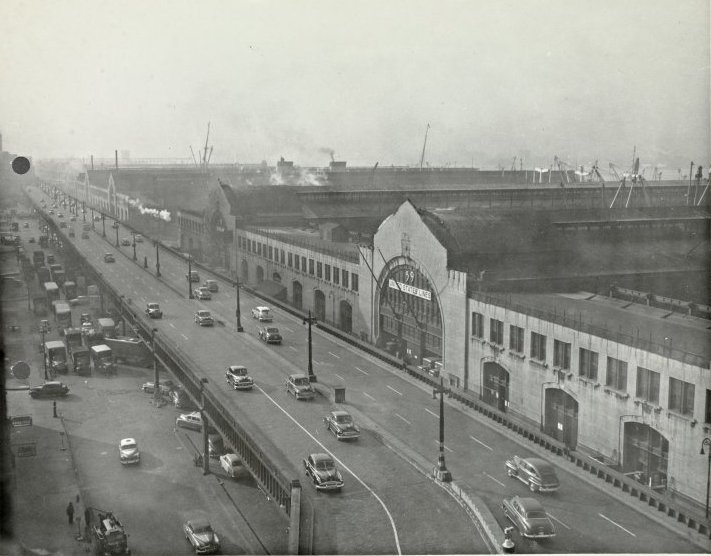
Where golf balls fly: Pier 59 at Chelsea Piers
The West Side Elevated Highway zooms past Pier 59, still in operation but long past her prime. (1951) Courtesy NYPL
There are very few angles on the 100th anniversary of the Titanic tragedy that aren't being excessively covered in other places this week. So instead of focusing on the ship and its passengers, I thought I'd look at some Titanic-associated places in New York that haven't been as breathlessly described or breathlessly refitted for 3-D.. For instance, the Chelsea Piers golf driving range.
The once-great West Side piers of the Gilded Age's finest luxury vessels sat mostly haunted and decrepit by the 1950s. The lust for ever grander vessels ultimately created boats that were too big for the piers to accommodate. Midtown piers took most of the traffic by the 1940s, and there seemed little to save along the western waterfront by the 1970s. Some piers burnt down and were never replaced; others became drab parking garages; and still others, a wonderful place to find a gay hustler.
Pier 59 had once been the berth of the White Star Line with a glamorous Beaux-Arts dock designed by Warren and Wetmore of Grand Central Terminal. By the 1990s, developers looked again hopefully for the pier to draw people of means. "This is where we'll put the golf driving range," said a developer of the Chelsea Piers Sports Complex to New York Magazine in December 1994. The immense rehabilitation project had already begun by then and would soon envelop four former piers.
The driving range arranges players on multiple levels, an innovation taken from Japanese driving ranges and described as "golf as imagined by Terry Gilliam." [source]
In June 1911, this pier welcomed its largest visitor, the White Star Olympic liner, on its maiden voice. The Olympic just happened to pass the Cunard's Lusitania in the New York harbor that morning. Of course, Pier 59 was to have greeted the Titanic on its arrival here on April 17, 1912, and leave again on April 20. But the gloom that hovered over the pier hardly slowed ocean traffic. The Olympic would continue to use the pier until it was pulled from service during World War I. On August 13, 1914, the ship Philadelphia arrived here with the first Americans fleeing the war.
Although most of the shipping industry avoided using Pier 59 by the 1960s, it did occasionally get some unusual arrivals. In 1960, the freighter Pioneer Tide arrived here with some unique passengers -- 13 one-humped camels.
Friday, March 23, 2012
The Bowery Boys High Line audio walking tour, featuring tales of the Titanic, the Manhattan Project and 1,000 Stevies
Cookie heaven: Trains pull into a factory owned by the National Biscuit Company, between W. 15th and 16th streets, July 30, 1950. Could those cars be filled with crates of freshly made Oreo cookies? (See comments section below for the anser.) By 1958, the snack company had pulled all production from New York's west side. Photo courtesy Ed Doyle/Flickr
PODCAST Welcome to our unofficial High Line audio walking tour! In our last podcast (episode #135), we gave you a history of the High Line, the one-mile linear park situated atop a stretch of abandoned elevated railroad tracks along the West Side. This time, I'll take you on a tour along the High Line itself.
This will incorporate some history of the elevated line itself, but it's geared towards describing the history of the surrounding neighborhoods. This is intended to be listened to as you walk along the High Line, beginning at the park's southern entrance at Washington Street and Gansevoort Street in the Meatpacking District. We'll end at 30th Street. This tour will last a little over an hour or so -- depending on what speed you choose to enjoy the High Line. But take your time!
Along the way, I'll share tales from almost 200 years of history, from the early days of Fort Gansevoort during the War of 1812 to the underground club life of the 1990s. Featuring New York stories of the Titanic, the Lusitania and the Manhattan Project. And starring a wild array of people who have influenced these neighborhoods, including Abraham Lincoln, Cornelius Vanderbilt, Drew Barrymore, REVS, Cass Gilbert, a feisty lady named Tillie Hart, and a whole lotta people dressed like Stevie Nicks.
ALSO: You might want a handful of Oreos after you're done.
To get the walking tour, simply download it for FREE from iTunes or other podcasting services, subscribe to our RSS feed or get it straight from our satellite site.
Or listen to it here:
The Bowery Boys High Line Walking Tour
This tour covers two hundred years of history, starting with the construction of Fort Gansevoort, built to protect the city from potential attack during the events leading up to the War of 1812. (Courtesy NYPL)
A map of the High Line, courtesy the Friends of the High Line. This walking tour follows this path directly from the southernmost entrance at Gansevoort Street, all the way up to W. 30th Street.
If you're not able to walk the High Line anytime soon, never fear! Google Maps actually allows you to 'walk' the High Line.
View Larger Map
Although you won't experience any vehicular traffic on this tour, please be aware of other visitors to the High Line as you listen. Stand over to the either side as you listen. There are some narrow paths, uneven walkways, benches and other nooks built into the surface of the High Line, so watch your step.
At the end of the tour I mentioned a Chelsea gallery tour that also provides a great perspective on the neighborhood while leading you through the scene's best art shows. You can find more information about tours at New York Gallery Tours. In addition to the Chelsea scene, they also provide guided tours of the Lower East Side and Upper East Side art scenes.
CORRECTION: There is a very hilarious mis-statement near the end of the show. The Morgan Processing and Distribution Center is 2.2 million square feet, NOT 2.2 square feet. That would be the size of a flower box, I think. I've added the correction to the podcast show notes.
Posted by
TUTULAE
Labels:
Abraham Lincoln,
Chelsea,
gay New York,
High Line,
Manhattan Project,
Meatpacking District,
Titanic
Subscribe to:
Posts (Atom)